Mask Machine Blade Size Chart — N95 / KN95 Cutter Blades
Mask machine blades have no universal part number. Here is the working size chart, what each part does on the line, and how to measure yours.
On an N95 or KN95 line, the parts that stop production are never the big ones. They are the small steel parts — the cutter blades, the nose-wire cutters, the paired scissors blades — and they stop it for a boring reason: nobody wrote the size down. Mask machine blades have no universal part number. Two lines from different builders can use blades with the same job and different dimensions, and the blade that came out of your machine is the only reliable way to order the next one.
This page is the working size chart we use, what each part does, and how to measure yours if it is not listed.
The standard mask machine blade sizes we supply
All dimensions in millimetres, length × width × thickness:
| Part | Size (mm) | Type |
|---|---|---|
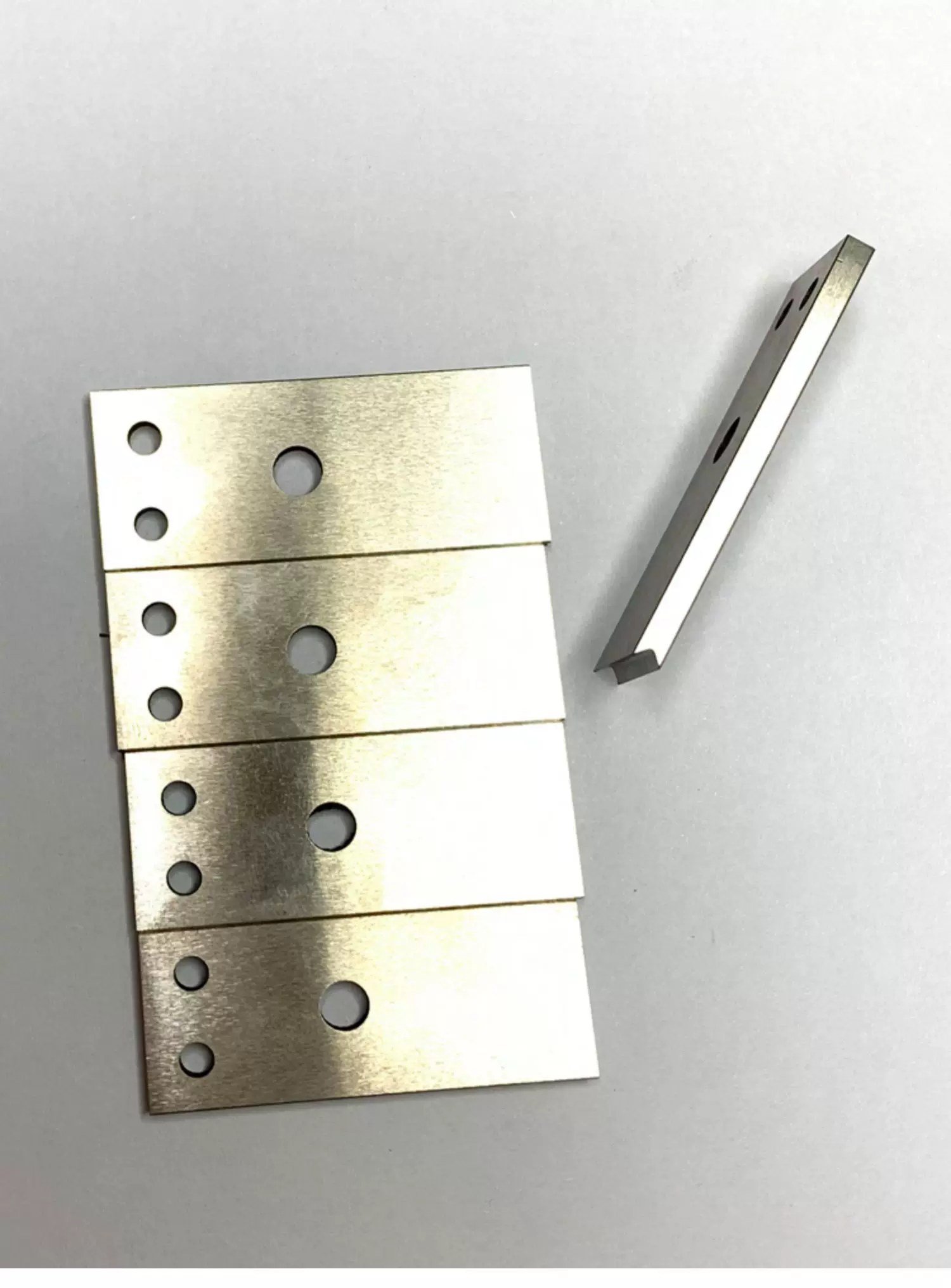
| N95 mask machine scissors blade | 52 × 27 × 4.5 | Double blade |
| N95 mask machine scissors blade (short) | 45 × 27 × 4.5 | Double blade |
| Mask machine scissors blade | 140 × 12 × 3 | Double blade |
| Cutting blade | 110 × 12.5 × 3 | Single cutter |
| Nose-wire cutter | 36 × 10 × 3 | Single cutter |
| N95 cutter | 44 × 14 × 3 | Single cutter |
| N95 cutter (new type) | 45 × 18 × 3 | Single cutter |
| Mask machine blade | 11 × 35 × 2.5 | Double blade |
These are nominal sizes. Always confirm against your machine, or send us the worn part — we measure it on our own equipment before quoting. The full mask machine blade range, with drawings is on its own page.
What each part actually does
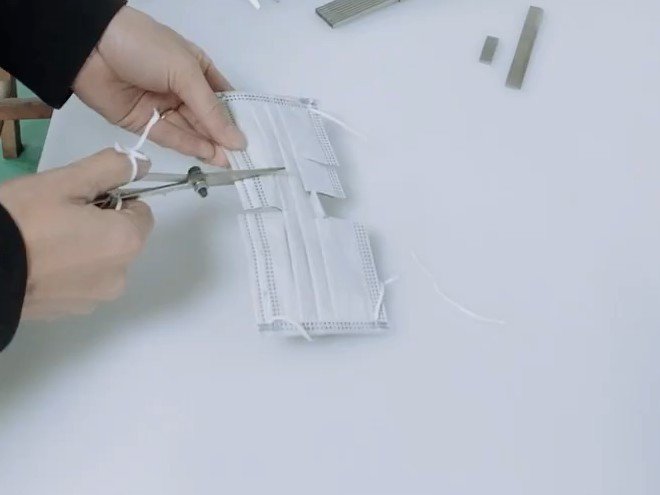
- Scissors blades (paired “double blades”) — two blades ground as a matched set so they shear against each other. They cut the ear-loop and the edge trim. Supplied as a pair, never singly, because a worn blade no longer matches its partner.
- Cutting blades (single) — cut against a hardened anvil or roller. This is the blade that slices the body of the mask out of the nonwoven web.
- Nose-wire cutters — the small blade that cuts the aluminium nose strip to length. Smallest part on the line, first one to go blunt.
How to measure your blade before you order
You do not need a drawing. You need calipers and three numbers:
- Length — the longest dimension, tip to tip.
- Width — across the blade at its widest point, not the cutting edge bevel.
- Thickness — measured on the flat body of the blade, away from the ground edge.
For paired blades also note the mounting hole diameter and spacing, and whether the pair is left/right handed. A photo of the worn blade with a steel rule laid alongside it is often enough for us to identify the part in a few minutes — see how we reverse-engineer a worn blade.
Why the same machine can take two different blades
Mask machine builders buy cutting stations from different suppliers, and revise them between batches. Add the fact that most lines are now several years old and have been serviced with whatever was available, and the result is that “the blade for an N95 machine” is not one part. We see this constantly: same machine model, two different blade sizes, both correct for their line.
This is also why ordering by machine model alone is risky. Send the worn part and we match the geometry you actually have.
Material and hardness: what decides blade life
Mask machine blades cut abrasive nonwoven and meltblown material, so the steel grade decides how often you stop to change a blade:
- Imported SKH-51 high-speed steel — the standard for mask machine scissors and cutters, hardened to HRC 65–68.
- SKH-9 high-speed steel — for blades where a tougher, less brittle edge matters more than maximum hardness.
- Tungsten carbide — for the most abrasive webs and the longest runs, HRC 62–64.
Tell us your material and line speed and we will spec the grade, or send the worn blade and we will match the original hardness.
If your blade is not on this chart
The chart is what we ship most often, not the limit of what we make. Send the worn blade and we measure it, redraw it with full GD&T, and return the drawing for your approval before anything is cut. There is no standard-size limit: oversized, extra-thick and solid carbide parts are all in range.
How ordering works
- Quote within 24 hours from a drawing, a photo, or the worn part itself.
- Free sample blade — fit it on your own machine before you commit. You cover the freight.
- Sample in 7–10 days, production in 30 days from the day you approve the drawing.
- MOQ 100 pcs for production runs.
Related: these blades are one half of a mask line’s consumables. The other half is the pneumatic air scissors and cutter heads used for ear-loop and edge trimming — that page lists the head lengths and jaw openings.
Send a photo of your worn blade today and we will match it from the contact page.