Cutting Blades for Textile & Nonwovens
Rotary and straight blades for fabric, spunbond, and hygiene lines — made to your drawing or sample.
Built for lines that can’t stop
Nonwoven and textile lines need consistent, fray-free cuts. Our custom blades for textile and nonwovens are made to your exact edge and tooth geometry. We can reverse engineer the blade from your worn sample when the drawing is gone.
Why buyers in Textile & Nonwovens choose HIBO
- Free sample — a working blade on your machine before you commit to 100 pcs.
- 24-hour quote — from the day we receive your drawing.
- 30-day lead — vs. the 35–45 days peers quote.
- Reverse-engineer — send the worn blade, get the drawing and a sample.
Typical applications
Apparel and garment cutting, spunbond and hygiene lines, technical textile slitting, and upholstery cutting.
What matters on a textile and nonwoven line
Nonwoven converting is where the cutting method matters more than the blade steel. A cold shear cut leaves a clean edge but can fray. A hot knife seals the edge and stops fraying, but the heat that seals also dulls and oxidises the edge. Ultrasonic cutting seals without contact heat, but the blade has to be tuned to the horn, and a worn blade shows up as a weak seal rather than a bad cut.
On mask lines specifically, the blade does two different jobs: the long straight blades that cut the mask stack to width, and the pneumatic scissors that trim the ear-loop and edge. They fail for different reasons and should be judged separately.
How a nonwoven blade fails — and what it tells you
- Frayed or hairy cut edge on cold-cut lines. The edge has dulled, or the anvil clearance is too wide.
- Hard, brittle, discoloured edge on hot-knife lines. Heat. The blade is being run too hot for its steel and is losing temper at the edge.
- Weak or intermittent seal on ultrasonic. Check the horn and the tuning first — a blunt blade on an ultrasonic stack often seals poorly rather than cutting badly.
- Pneumatic scissors that stop cutting cleanly. Usually the blade head, not the air cylinder. Look for a nick or a rounded edge before rebuilding the unit.
Blades we supply for nonwoven and textile
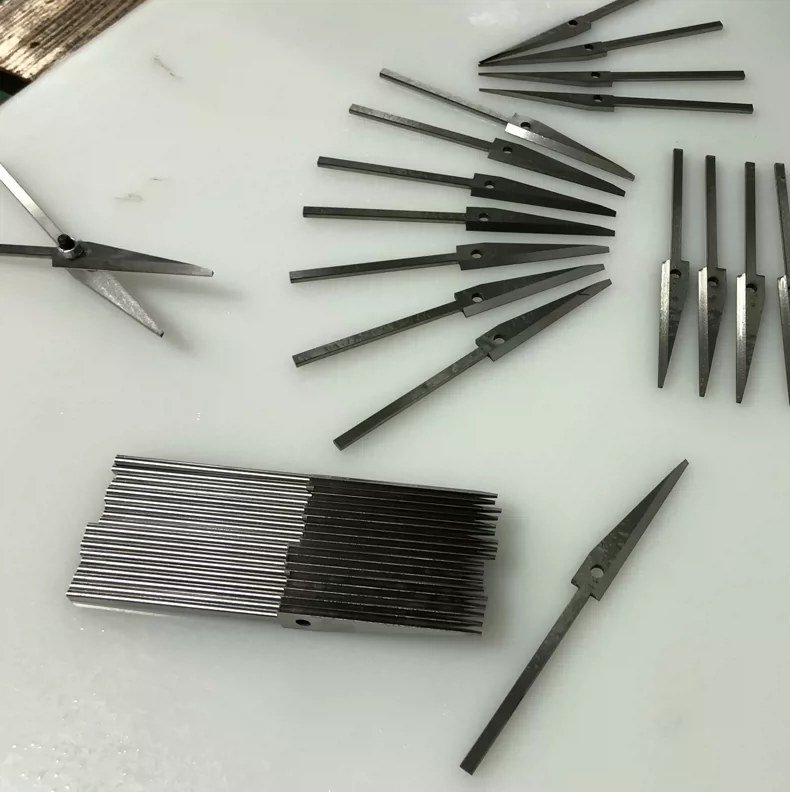
- Mask machine long blades — paired straight blades for N95 and KN95 lines, in the common section sizes and to your drawing.
- Pneumatic air scissor blade heads — replacement heads for the scissor units on mask and nonwoven lines.
- Slitting knives for spunbond and hygiene lines — shear and crush-cut.
- Garment and upholstery cutting blades — straight knife and rotary.
Nonwoven and textile blades — common questions
Which blade do I need for my mask line?
Tell us where it sits: the long blade that cuts the stack to width, or the scissor head that trims the ear-loop. Send the worn part, or a photo of it in place — the machine model alone is not enough, because the same model can be set up differently.
How often should mask machine blades be changed?
There is no honest number without your line speed, material and stack height. The signal to watch is the cut edge: when the mask edge starts to show fibres, or the stack no longer separates cleanly, the blade is done. Some plants change on a fixed interval, which is fine as long as the interval comes from their own wear data and not from a catalogue figure.
Are the long blades supplied in pairs?
Yes. They are made and marked as a matched pair, because the cut depends on the pair, not on one blade alone.
Most nonwoven converting lines also run air scissors. Start with the pneumatic air scissors range, or go straight to the mask machine blade size chart.
Running a textile line?
Send a drawing or a worn blade. Free sample, you cover the freight.